This week I enjoyed looking at Rachael and Samantha's blogs. Rachael delved into and showed examples of Josef Hoffman's furniture style and functionality, and then showed gave examples of modern pieces seen today. Samantha talked about how the Werkbund movement took the quality and style of the arts and crafts period, however used mass production in coordination with design professionals and product manufacturers.
Rachael's blog--->http://history2rap.blogspot.com/
Sam's blog--->http://history2sjn.blogspot.com/
Sunday, September 7, 2014

Putting in Work. Deutscher Werkbund.
Deutscher Werkbund was the German Association of Craftsmen formed in 1907. The Werkbund emerged after architect Joseph Maria Olbrich left Vienna and moved to Darmstadt, Germany, after Ernest Louis invited him to start up an artists' group.

Known as the largest and most influential design reform organization in Europe, the Werkbund consisted of a number of architects, artists, and business owners. The Werkbund wanted innovation in the domestic environment, and hoped to unite deep German values within forces of industrialization.
Quality was very important and honest materials and great workmanship was expected. Sachlichkeit was the functional new approach to design. Uncluttered, unornamented, and functional designs were the new thing. Women played a prominent role in teaching other women and shop girls about the new reform. Women felt the need to modernize their taste within this machine age.

.gif)


The Werkbund Ways
Known as the largest and most influential design reform organization in Europe, the Werkbund consisted of a number of architects, artists, and business owners. The Werkbund wanted innovation in the domestic environment, and hoped to unite deep German values within forces of industrialization.
Quality was very important and honest materials and great workmanship was expected. Sachlichkeit was the functional new approach to design. Uncluttered, unornamented, and functional designs were the new thing. Women played a prominent role in teaching other women and shop girls about the new reform. Women felt the need to modernize their taste within this machine age.
Werkbund Exhibition
The first exhibition was held at Rheinpark, Cologne in 1914. It opened May 15th and was scheduled to last until October, however was shut down early due to World War I outbreaks. One of the most popular items in the exhibit was the Glass Pavilion by Bruno Taut. It was a prismatic concrete dome with colorful inlaid glass that acted as mirrors. It is Taut's best known work of architecture.
Bauhaus
Another contribution from Werkbund was Bauhaus. An art school for crafts and fine arts, operated from 1919 to 1933. Bauhaus became known for architecture, interior design, graphic design, industrial design, and
typography. Bauhaus had sites in Weimar and Dessau.
Modern Application
Art Nouveau Discussion
Several other blogs I viewed were Chanel's and Rose's. I liked how Chanel talked more about Henry Van De Velde and mentioned that he designed his own home. Looking through Rose's images, I enjoyed seeing the Carson's department store storefront, located in Chicago. It was a great example of showing how we can really see this style within a city close to us.
Chanel's blog--->http://history2cac.blogspot.com/
Rose's blog--->http://history2rk.blogspot.com/
Chanel's blog--->http://history2cac.blogspot.com/
Rose's blog--->http://history2rk.blogspot.com/
Looking for something new! Art Nouveau
Design Characteristics
Rejecting the traditional and academic styles that were popular, new designs incorporating natural forms and curved lines became quite the trend. Art Nouveau is not solely a style of architecture. It encapsulates all types of art and design ranging from graphic art, jewelry, interior design, furniture, and other household goods.
Art Nouveau is one of the first artistic movements in which graphics were mass-produced rather than printed traditionally one by one. One example is when a paris based artist, Alphonse Mucha, used lithography to mass produce posters for the streets of Paris.


The architecture of this time made great use of emerging technologies such as the innovation of exposed iron and bent glass.

Modern-Day Applications

Monday, August 25, 2014
Let's Do Arts and Crafts!
The Arts and Crafts Movement started as a reaction against the Victorian Period. Flourishing in 1880 through 1910 and even influencing the 30's, it was headed by the artist, poet, and designer William Morris. The design styles were formed in the British Isles and focuses on anti-industrialism and quality.
In North America and the United States, Arts and Crafts was less of a Movement, more focused solely on architecture and interior design from 1910-1925. While Europeans thought of Arts and Crafts in terms of revolting against industry, the United States took it as an opportunity to rekindle craft production.


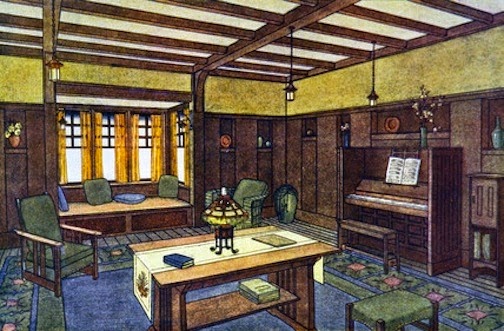

In North America and the United States, Arts and Crafts was less of a Movement, more focused solely on architecture and interior design from 1910-1925. While Europeans thought of Arts and Crafts in terms of revolting against industry, the United States took it as an opportunity to rekindle craft production.
Design Principles
The Arts and Crafts design style strove to provide simple and clean aesthetics. No excessive decorations are used, unique and non-mass produced items are popular. The use of natural materials, wood, stone, and brick is common. Built-ins and woodwork are extensive. Fireplaces, low-pitched roofs, exposed beams, stained glass, and coordinating fixtures are also common styles. Many interiors reflect some qualities of Japanese design as well.
Modern Day Application
Monday, April 14, 2014
Discussion - French Design
The first blog I looked at was John's. He posted about French Renaissance style. I enjoyed reading about his findings about the chateau.
Here's his post: http://www.history1jpe.blogspot.com/2014/04/french-renaissance.html
I also looked into Flor's blog post which was also on French Renaissance design. She focused on how politics really controlled the arts and designs of the time, and how kings and rulers lived in castles.
Check out her post here: http://www.history1fh.blogspot.com/2014/04/french-renaissance-neoclassic.html
Here's his post: http://www.history1jpe.blogspot.com/2014/04/french-renaissance.html
I also looked into Flor's blog post which was also on French Renaissance design. She focused on how politics really controlled the arts and designs of the time, and how kings and rulers lived in castles.
Check out her post here: http://www.history1fh.blogspot.com/2014/04/french-renaissance-neoclassic.html
French Rococo Style
This new style began in the early 18th century in Paris, France. It was a movement away from the stern and symmetrical Baroque designs toward more fluidity and gracefulness. This new movement was mostly headed by women with power, such as King Louis XV's mistress, Madame de Pompadour. She was highly involved in the new flourishing arts of France. Her time was spent amassing personal furniture and creating growth within the porcelain industry in Serves. The time of Louis's reign is said to be the pinnacle of French architecture and interior design.


 |
| Madame de Pompadour |
Major Style Characteristics
This new style was breaking away from the straight lines and guided rules of the Baroque period. Rococo style was enraptured in feminine qualities and curved, natural lines. Lighter colors and pastels were most common, along with gilding in gold and white. Ornamentation from previous times was still popular, however, in a more subtle and elegant way. The name Rococo is said to be derived from French terms rocaille (stone) and coquilles (shell) due to the use of these in many motifs of the time.
Interior Architecture
Rooms were built in rounded shapes with tall and elongated walls and windows. Although more subdued, the ornamentation within interiors still included intricate mirrors, light fixtures, and some wall details.
Furniture
Furniture layout was still similar to the Baroque in which the pieces were lined against the perimeter of rooms.
French Rococo as seen Toady
Subscribe to:
Posts (Atom)